Human-Verified Predictive Maintenance: How Waites Built The Ecosystem You Can Trust
Read why our model valuing partnership and championing human-validated intelligence makes all the difference.
- Waites Sensor Technologies: Wireless Condition Monitoring Service At-A-Glance
- Unmatched Reliability with Waites Sensor Ecosystem: AI-Condition Monitoring and Certified Vibration Analysis
- Industrial-Grade Hardware That Earns Its Place on Your Equipment
- Unmatched AI Models Trained on Over 13 Trillion Sensor Readings
- The Human Advantage: Why Certified Analysts Are a Feature, Not a Limitation
- Architecture That Scales Without Compromise
- A Proven Solution That Works in Any Situation
- What a Truly Integrated Ecosystem Looks Like
- Waites Sensor Technologies Client Testimonials
- Why Full Automation, No Humans, Won’t Work
Waites Sensor Technologies: Wireless Condition Monitoring Service At-A-Glance
The condition monitoring market is crowded with promises.
✅ Autonomous AI.
✅ Fully automated diagnostics.
⁉️ Zero human involvement.
It sounds compelling in a bid for your business. But for the maintenance and reliability professionals responsible for keeping production running, an AI solution must do more than detect anomalies and generate more alerts. It must deliver validated, prescriptive guidance from a real reliability partner you can trust who walks the talk and truly knows how your operations run.
Unmatched Reliability with Waites Sensor Ecosystem: AI-Condition Monitoring and Certified Vibration Analysis
The AI-first market is noisy, but our signal is clear: you need both rugged, high-fidelity sensors for any environment, hazardous included, and certified human validation. Real data combined with real confidence.
This powerful combo values human accountability and partnership, two crucial components that matter when production and reputation are on the line. Choosing one while foregoing the other (AI > Humans) for the sake of speed and scale sounds a lot like another kind of reactive model that can lead to failure without oversight. “Set it and forget it” just doesn’t work.
Waites Sensor Technologies was built on a conviction:
The most powerful predictive maintenance system in the world is one that combines industrial-grade sensing, proven AI, and certified human expertise into a comprehensive workflow.
Not AI alone. Not analysts working without it. Both working together, in near real time, to make sure the world’s supply chain has fewer emergencies.
Here’s why that matters to your unique operating conditions, and why the specs back it up.
Industrial-Grade Hardware That Earns Its Place on Your Equipment
At Waites, our philosophy has always been simple: a sensor for every situation. Across more than half a million sensors installed on six continents, we’ve learned that not every asset requires the same depth of analysis—but every asset deserves the right level of protection.
Our SM7, S4B and SV5 sensors were designed to reflect that principle, offering a tiered approach that optimizes both coverage and cost while delivering reliability performance in proportion to asset criticality.
SM7
The SM7, our flagship and most advanced wireless reliability sensor, represents the pinnacle of Waites engineering and predictive capability. Built for harsh and hazardous environments, SM7 is intrinsically safe and certified for Class I, Division 1 (C1D1) hazardous locations, with an IP69K-rated enclosure and over-the-air configurability.
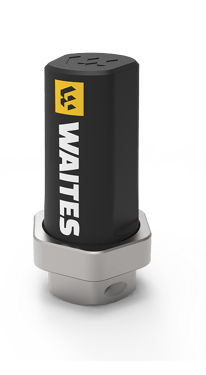
SM7 delivers:
- Fmax of 11.2 kHz and an 88 kHz decimated sample rate, ensuring complete visibility across the entire vibration spectrum.
- ImpactVUE® ultrasonic demodulation, based on readings up to 44KHz (well into the ultrasonic range), detecting the earliest bearing and lubrication failures well before they manifest in standard frequency ranges.
- Long time waveform capture for slow-speed and complex rotating assets, enabling fault detection down to 1 RPM.
- Advanced filtering and synchronous multi-axis and multi-sensor readings (within 5 microseconds), unlocking deep diagnostic techniques such as phase and asset-train analysis.
- Intrinsic safety ratings, harsh-environment durability, and over-the-air configurability across virtually all operating conditions.
In short, the SM7 is purpose-built for critical assets—high-speed (and ultra-low RPM), high-value equipment whose unexpected downtime carries major operational impact. It is the foundation of Waites’ industry-leading predictive accuracy, verifiably detecting over 99.9% of downtime-causing events.
S4B
The S4B is the most capable sensor in its size, delivering SM7-level performance in a smaller, tethered form factor ideal for spaces with washdowns like food and beverage. Designed for applications where such space, mounting constraints, or continuous power are considerations, the S4B retains the core capabilities that define Waites’ predictive accuracy.
This smaller, tethered sensor features the same high-frequency response, advanced accelerometers, and ImpactVUE® ultrasonic detection as the SM7. It enables early fault detection across the full vibration spectrum, including bearing and lubrication issues that lower-resolution sensors miss.
By bringing this level of performance into a compact, hard-wired design, the S4B extends high-fidelity monitoring to assets where a wireless deployment may not be the suitable fit, without compromising on data quality or diagnostic depth.
SV5
The SV5 is a compact, hard-wired tethered sensor designed for easy installation in tight or demanding industrial environments. Delivering mid-frequency, high-g, tri-axis vibration, and precision temperature sensing, it provides early visibility into developing faults to help teams act before unexpected failures occur.
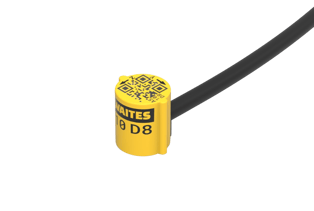
With an IP67-rated enclosure and a 10-ft tethered cable, the SV5 supports continuous, direct-connect monitoring in space-constrained applications. Its small form factor allows it to fit virtually anywhere, making this sensor a practical solution for machines that require dependable condition monitoring in compact installations.
SV5’s key capabilities include:
- Tri-axis vibration, ±16 g (up to 4.2 kHz Fmax)
- Temperature range: -40 to 221°F (±1°F accuracy)
- IP67-rated enclosure
- Compact 0.53 in form factor
- 10-ft tethered cable
AI Models Trained on Over 13 Trillion Sensor Readings
Some vendors talk about machine learning as if installing a sensor and connecting it to the cloud constitutes an AI strategy. Waites has been refining its models for nearly two decades, and the numbers reflect that head start.
Our AI-driven predictive maintenance and condition monitoring solution also eliminates the false choice between protect everything and stay within budget. A proprietary wireless cloud stack enables economic deployment at 10x the competitor sensor density, while certified analysts provide the human accountability executives demand from a technology solution.
Waites’ industrial-optimized cloud stack offers high-volume ingestion, long-term retention, and AI-assisted diagnostics. New patterns create new models without overwriting history, while analyst feedback continuously sharpens alerts and improves accuracy over time.

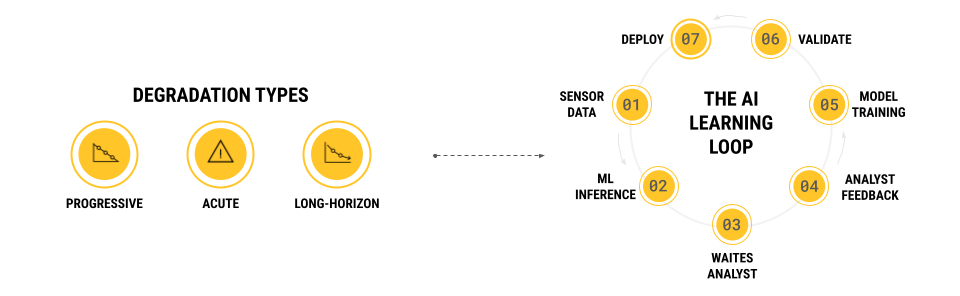
Smart AI and even smarter people inform the AI learning loop; Waites.
Waites AI models are trained on more than 13 trillion sensor readings and learn from 10 billion new datapoints every day.
These models not only flag when a vibration threshold is crossed, but also recognize evolving failure patterns often months in advance. This predictive capability gives maintenance teams a planning window to transform reactive firefighting into deliberate, scheduled intervention.
The feedback loop between these AI outputs and human analyst validation continuously improves model accuracy. Every time a certified analyst reviews, confirms, or refines a diagnosis, that intelligence flows back into the models. The system gets smarter because our humans are part of the process, not removed from it.
The Human Advantage: Why Certified Analysts Are a Feature, Not a Limitation
This is where Waites makes its most important and most misunderstood bet.
Some competitors position fully autonomous diagnostics as the gold standard, arguing that removing humans from the diagnostic chain makes the system faster and more scalable. Sounds efficient in theory. In practice, however, it introduces a significant risk: what happens when the algorithm is wrong?
A false positive in a fully automated system generates an unnecessary work order, pulling technicians off productive tasks to investigate a machine that’s running fine. A false negative allows a developing fault to progress undetected because the model didn’t recognize the pattern in that specific operating context. Both scenarios cost money. Both erode trust in the system. And both happen more frequently than vendors of fully autonomous solutions tend to admit, because real-world machinery failure is messy, contextual, and influenced by many complex variables. For example: load profiles, ambient conditions, recent maintenance history, and product changeovers. Variables that algorithms working alone struggle to interpret.
Waites took a fundamentally different approach: smart sensors, smarter people.
Before any alert reaches a maintenance team, it’s reviewed by a CAT-certified vibration analyst. Humans are critical to our solution, confirming whether the AI’s diagnosis is correct and adding operational context like assessing severity in the context of production schedules. Partnering with Waites not only delivers AI-powered condition monitoring but actual prescriptive guidance tailored to the specific facility and equipment. Reliability teams never receive raw charts or vague recommendations. They get clear insights backed by data that’s refined by the experts who know and understand the operating environment.
Through Waites’ 24/7 service model, industrial clients work with one lead analyst who knows their environment and unique operational conditions, and who can address their specific maintenance concerns. Working as true reliability partners, as an extension of your team, our entire job is understanding your site and the health of your rotating equipment. That first-hand perspective allows us to prioritize equipment problems and reduce alarm fatigue using advanced tools in the most efficient ways. Dependable sensors and proven AI led by industry savvy analysts who translate alerts into actionable, scalable insights.
Commercial aviation doesn’t eliminate pilots because autopilot technology has advanced. Financial institutions don’t remove human risk managers because algorithmic trading has matured. In high-stakes environments, the combination of machine speed with human judgment consistently produces better outcomes than either one in isolation. Industrial maintenance is no different.
Architecture That Scales Without Compromise
Waites’ system was engineered for large-scale industrial deployment from the ground up, not adapted from a consumer IoT platform after the fact.
Each gateway manages thousands of sensors per gateway without signal degradation using 802.15.4 protocol, and with a line-of-sight range of 900 meters that's extendable with repeaters. Each wireless node supports up to six sensor points providing 18 channels of coverage, with readings that can be customized to run on intervals or triggered on demand. In terms of density of coverage, a single deployment can monitor an entire production line, an entire building, or an entire facility without the connectivity bottlenecks or gateway limitations.
The architecture doesn’t require programmable logic controller (PLC) access, firmware changes, or IT involvement. Instead, it operates on an air-gapped mesh network that mitigates cyber risk. Waites also integrates with existing computerized maintenance management systems (CMMS) to support work order management and execution.
Waites offers a seamless wireless condition monitoring system that’s:
- Powered by an encrypted cellular connection.
- Incredibly easy to install.
- Usually up and running in minutes.
A Proven Solution That Works in Any Situation
Claims are easy to make. Outcomes are harder to manufacture. Waites clients have saved multimillions in downtime costs annually, with hundreds of thousands of sensors installed and monitored worldwide.
These results aren’t from pilot programs or controlled demos but are based on sustained, full-scale deployments across industries, including cement, mining, food and beverage, pharmaceuticals, chemicals, and facilities management.
Buzzi Unicem, a global cement manufacturer, recently achieved a 3-month ROI and saved hundreds of thousands of dollars by preventing unscheduled downtime. This timeline reflects both the speed of deployment and the immediate diagnostic value that analyst-verified monitoring delivers from day one. The resulting testimonial from this partnership lays a solid foundation for how our team delivers: “Waites has been the biggest game changer for us within the cement industry in the last 20 years.”
Waites is certified around the world and offers communications in 13 languages, with service and installation teams available globally. We’re not a regional startup scaling our first product. We’re an established industrial technology company with the operational infrastructure to support multinational deployments.
What a Truly Integrated Ecosystem Looks Like
Waites doesn’t stop at monitoring. The platform delivers every reading to a customized dashboard that gives plant personnel a complete view of their operation. A Waites analyst updates maintenance teams via text message, email, or phone call when equipment conditions exceed automatic or manually set thresholds for spectrum vibration, overall vibration, temperature, humidity, and more. A full record shows who reviewed each alert and how it was handled.
Through partnerships like our recently announced integration with MaintainX, Waites connects real-time asset health with work execution, closing the gap between detection and repair with analyst-verified work orders that include summaries, recommended actions, and direct links to full diagnostic detail. The result is a closed-loop workflow: a high-fidelity sensor detects an anomaly, AI flags the pattern, a certified analyst verifies the diagnosis, a work order is created with prescriptive guidance, and the repair is tracked to resolution.
Waites Sensor Technologies Client Testimonials
Installing the Waites system was one of the easiest decisions we’ve made. It’s a small investment compared to the $11 million we saved.
The metrics speak for themselves. I sleep at night because I’m not getting calls at 3 or 4 in the morning because a large piece of equipment has gone down.
Our objective is to move from reactive to preventive maintenance, and Waites’ technology has been crucial in this transformation. Now, instead of getting a report once a month, we receive action items on the dashboard as soon as an issue is detected.
Our goal is to transition from a reactive to a proactive maintenance approach, and Waites’ technology has been instrumental in this shift.
Waites has the hardware, software, human intelligence, and proven ability to solve the problem of unexpected downtime, extend equipment life, revolutionize the way facilities perform maintenance, and make the world run more smoothly.
RTO fan motor degradation caught before failure. 16 hours of peak production downtime avoided.
Emerging bearing failure caught early with Waites. Prevented 48 hours of downtime.
Early detection of concerning vibration levels on NDE bearing. Avoided 4 day outage.
Conveyance misalignment detected early. Issue resolved in 8 days from initial alert.
Why Full Automation, No Humans, Won’t Work
Predictive maintenance is a journey. If you take the path leading toward full automation, with systems that generate alerts, create work orders, and scale without human involvement, you risk noise and missed priorities. Sure, that works for simple, low-consequence applications, but it may be insufficient for global enterprises with operational complexity. Where expertise counts.
Consider the operations where unplanned downtime costs six or seven figures per incident, where safety is non-negotiable, and where the difference between a correct diagnosis and a guess can mean the difference between a scheduled repair and a catastrophic failure. In these applications and environments, the answer isn’t less human involvement. It’s better human involvement, amplified by world-class technology.
To that end, Waites delivers. Our diverse sensors are industrial-grade, C1D1-rated, and built to capture fault signatures that standard monitoring misses. Our AI grows more intelligent every day with analyst feedback. And Waites certified analysts stand behind every recommendation based on verified intelligence.
Scaling with a team of human experts is not a limitation. It’s how we build an ecosystem you can trust.
- AI condition monitoring for optimal performance.
- Expert industry guidance for fewer emergencies.
- Human accountability for long-term maintenance support.
The world’s most critical operations deserve a real partner who can deliver a comprehensive, trusted system that actually works.
Frequently Asked Questions About Waites Sensor Technologies
What is the difference between SM7 and SV5 sensors?
The SM7 is a flagship, intrinsically safe sensor (C1D1) designed for critical and hazardous assets, featuring ultrasonic demodulation and low-RPM detection. The SV5 is a compact, tethered sensor ideal for space-constrained applications, providing mid-frequency tri-axis vibration and precision temperature monitoring.
How does human verification improve AI predictive maintenance?
Human verification involves CAT-certified vibration analysts reviewing AI-enabled alerts to provide operational context and prescriptive guidance. This process eliminates false positives, provides diagnostic accuracy for complex machinery, and creates a feedback loop that continuously improves the underlying AI models.
Can Waites sensors be used in hazardous industrial environments?
Yes. The Waites SM7 sensor is specifically purpose-built for harsh conditions. It is intrinsically safe and certified for Class I, Division 1 (C1D1) hazardous locations, featuring an IP69K-rated enclosure and over-the-air configurability for maximum durability.
How long does it take to install the Waites condition monitoring system?
The Waites system is designed for rapid, plug-and-play installation. Because it utilizes an air-gapped mesh network and encrypted cellular connection without requiring PLC access, the system can typically be up and running within minutes.