The People Behind the Platform: Why AI-Powered PdM Still Needs Human Insight
Every year, maintenance teams are promised that AI will take care of everything. However, anyone who’s spent time on a plant floor knows it’s never that simple.
AI has changed the way we monitor machines, no question. Algorithms process billions of data points and detect subtle patterns that might indicate wear, imbalance, or misalignment. But machines can’t tell you what those patterns mean in context to your unique environment: why they matter, how urgent they are, or what actions will prevent a failure without wasting resources.
AI in Predictive Maintenance
Why does predictive maintenance still require human analysts?
Good maintenance practice isn't just about using data effectively. It's also about applying good judgment. Timing, process, and intuition still drive the best decisions. That’s why the most effective predictive maintenance (PdM) programs aren’t fully automated. They’re guided by humans who understand real-world environments.
At Waites, we believe the real power of AI comes from how it works with people. By combining advanced machine learning with CAT II vibration analysts who interpret, validate, and prioritize insights before they ever reach your dashboard, we turn predictive data into confident, actionable decisions. The result is a platform that empowers teams (not replaces them) and delivers reliability that’s both intelligent and human centered.
The Risk of AI-Only Monitoring: Noise
Is AI alone enough for predictive maintenance in industrial environments?
AI and IIoT platforms have made it possible to collect more data than ever before. Every piece of equipment, every bearing, and every motor can now deliver a continuous stream of vibration, temperature, and performance information. The catch is that more data doesn’t always mean more clarity.
How do false alarms impact maintenance teams?
Without human expertise to interpret it, this flood of information can quickly turn into noise. Maintenance teams can often find themselves overwhelmed by frequent alerts, unsure which ones signal real risk and which are routine fluctuations. This “alert fatigue” not only wastes valuable time but can also lead to missed priorities and delayed responses when issues truly matter.
Why does AI trigger false positives in PdM?
Consider a simple example. A sudden vibration spike might appear on a dashboard, suggesting a potential bearing defect. In reality, it could have been caused by a temporary process change on the line. An experienced vibration analyst can tell the difference, applying mechanical understanding and operational context to separate the signal from the noise.
What Our Vibration Analysts Bring to the Table
Behind every Waites PdM insight is a team of certified vibration analysts who verify each alert is accurate, relevant, and worth your team’s time. While AI identifies patterns, it’s human expertise that gives those patterns meaning.
-
Experience That Sees Beyond the Data
Waites analysts have decades of hands-on reliability experience across thousands of machine types and operating conditions. They know how a motor should sound, how a pump should feel, and when a vibration signature signals something more than background noise. That experience and partnership with the team onsite allows us to interpret subtle changes AI might misread and confirm what’s truly worth acting on.
-
Context That Algorithms Can’t Replicate
Data can't tell the full story. And analysts don’t just interpret numbers. They collaborate directly with your maintenance team to understand what’s happening on the floor. Together, we account for context like temperature swings, seasonal demand, or shift changes to see the full picture and filter out false alarms.
-
Prioritization That Protects Uptime
Not every alert deserves the same attention. Waites analysts rank issues by severity and urgency, helping maintenance teams spend less time filtering through noise and more time preventing downtime.
-
Communication That Drives Confident Action
AI can detect anomalies, but analysts turn those findings into clear, prescriptive recommendations delivered directly through the Waites dashboard. Every insight includes the “why” and the “what next,” so teams know exactly how to respond without any guesswork or wasted effort.
-
Validation That Keeps AI Smart and Reliable
Most PdM platforms rely on plant technicians to validate AI alerts, which can unintentionally teach the algorithms bad habits. If an AI flags a potential bearing issue and a technician dismisses it as a false alarm, that “no problem” feedback becomes part of the model’s learning. Then, the next time a similar pattern appears, it may be ignored entirely.
Waites takes a different approach: every AI alert is reviewed and validated by our CAT II+ certified vibration analysts rather than whoever’s on shift at your organization. Only accurate, expert-confirmed data is fed back into the machine learning, so the system can learn the right lessons, improve over time, and scale accurately across every site.
Where machines add leverage and where human judgment remains indispensable.
|
Capability |
Artificial Intelligence (AI) |
CAT II Analyst Oversight |
|---|---|---|
|
Strength |
Speed and Volume |
Context and Prescriptive Action |
|
Speed |
Processes thousands of mentions, articles, or data points in seconds |
Steady and deliberate; can pause to weigh the nuances |
|
Volume |
Scales infinitely across channels, languages, and time zones |
Bandwidth-limited; triages and prioritizes |
|
Context |
Surface-level pattern matching; misses sarcasm, subtext, cultural cues |
Reads the room and understands stakeholder history, political climate, and unspoken dynamics |
|
Prescriptive Action |
Flags anomalies and suggests generic responses |
Recommends tailored moves based on relationships, timing, and strategic goals |
|
Best Used For |
Monitoring, aggregation, first-pass analysis, draft generation |
Judgment calls, crisis response, executive counsel, narrative strategy |
|
Risk if Used Alone |
False positives, miscalibrated outputs, missed subtext |
Slow reaction, narrow coverage, monitoring gaps at scale |
|
Ideal Workflow |
Handles the “what” and “how much” |
Owns the “so what” and “now what” |
How Waites Combines AI and Expert Analysis to Deliver Trusted Results
Our artificial intelligence works hand in hand with human expertise to deliver insights that are accurate, actionable, and built on real-world understanding.
- Always-On Insights
Waites sensors continuously monitor vibration, temperature, and other key performance metrics. Our AI is trained on more than 13 trillion datapoints and 10 billion daily readings to effectively detect early signs of wear, imbalance, or impact events long before failure occurs. - Expert Validation
When an anomaly appears, it’s separated by degradation type (progressive, acute, and long-horizon) and reviewed by a certified vibration analyst. They determine severity, confirm the cause, and filter out false alarms so only real issues reach your team. - Actionable Guidance
Action items are delivered through the Waites dashboard with clear, prescriptive recommendations. Teams get the “what,” “why,” and “what next,” allowing them to act quickly, confidently, and with complete trust in the data. - Continuous Learning
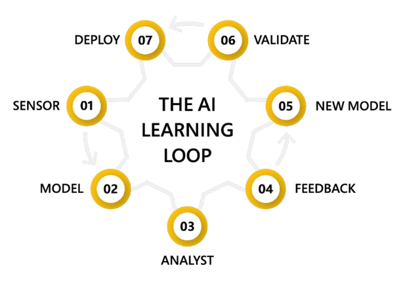
Each interaction between AI and analyst strengthens the system. New patterns refine models without erasing history, while expert feedback sharpens accuracy over time. This ongoing loop—sensor → model → analyst → feedback → deploy—keeps Waites adaptive, transparent, and smarter with every cycle.
Real-World Results of Human + AI Collaboration
Across industries, Waites customers are seeing results that prove the power of human and AI collaboration.
🔋 An energy services provider used Waites to detect a pump degradation early, preventing a failure that would have cost over $250,000 in unplanned downtime.
🏭 At a major manufacturing facility, verified insights helped identify a bearing defect before it caused a line stoppage, saving $330,000 and avoiding more than 100 hours of lost production.
📈 And in a high-demand processing plant, analysts caught a developing fan imbalance early, allowing technicians to correct the issue before failure, prevent $40,000 in potential downtime costs, and extend the asset’s lifespan by several years.
These outcomes aren’t one-offs. They’re consistent results that show what’s possible when artificial intelligence and human expertise work hand in hand. Roles organization-wide can feel the benefit of our proven system: operations leaders get clarity they can trust, maintenance managers have fewer fires to fight, and technicians on the floor spend less time guessing and more doing.
The Evolution of Predictive Maintenance: Human-in-the-Loop AI
Can AI replace vibration analysts?
Predictive maintenance is evolving, not to replace people, but to empower them. The future of reliability combines intelligent technology with human expertise, creating a partnership where data becomes understanding and insight becomes action.
The next generation of maintenance excellence balances AI that learns and people who listen, interpret, and act.
At Waites, we’ve built that future today. Our model makes sure technology serves people, not the other way around, by keeping human insight at the heart of every decision. Together, we’re redefining what reliability looks like in the age of AI.
See our AI-powered condition monitoring and predictive maintenance solution in action.
