Wired vs. Wireless Condition Monitoring for Aging Industrial Equipment: A Buyer’s Guide
If you’re responsible for maintaining rotating equipment in a plant that wasn’t designed with modern monitoring in mind, you’ve already confronted the question, “do we wire it, or go wireless?”
It sounds like a technology preference, but it isn’t. This is a capital decision, an installation risk, and, if you get it wrong, a reason your predictive maintenance program stalls before it delivers any value. This guide walks through what actually differentiates wired and wireless condition monitoring systems for aging and legacy equipment, when each approach makes sense, and how to structure your decision before you issue a purchase order.
Why the Choice Is Harder on Aging Assets
Newer facilities can often plan monitoring infrastructure into construction. Aging plants and critical industrial infrastructure such as refineries, paper mills, cement facilities, and steel and mining operations were designed around manual inspection routes, not continuous sensor feeds. That creates three compounding problems:
- Conduit and cable runs are expensive or structurally impractical. Running shielded instrumentation cable through a 40-year-old facility with limited cable tray, hazardous area classifications, and active production schedules is rarely straightforward.
- The equipment itself may lack accessible wiring ports or standardized mounting surfaces. Older motors, gearboxes, and pumps often require adapter plates or custom brackets before any sensor can be attached.
- Maintenance resources are already stretched. A monitoring system that creates new inspection and upkeep obligations competes directly with the labor it was supposed to free up.
The wired-vs.-wireless question is not only focused on signal fidelity, but also whether monitoring infrastructure can actually be deployed, maintained, and expanded without becoming its own maintenance burden.
Side-by-Side Comparison
|
Factor |
Wired Systems |
Wireless Systems |
|
Installation complexity |
High: Requires conduit, cable pulls, terminations, often area classification compliance |
Low to moderate: Sensor mounting, battery installation or power tap, gateway placement |
|
Upfront cost |
Higher: Installation labor often exceeds hardware cost |
Lower: Sensor and gateway hardware without cable infrastructure |
|
Coverage expansion |
Difficult and costly: Each new point requires new runs |
Scalable: Add sensors within gateway range without infrastructure changes |
|
Legacy equipment compatibility |
Varies: Wiring access may require equipment modification |
High: Wireless sensors mount externally; no internal access required |
|
Data frequency |
Continuous streaming possible |
Configurable: From minutes to continuous, depending on system |
|
Maintenance requirements |
Cable integrity, connector corrosion, junction box inspection |
Battery management (or energy harvesting), gateway firmware, RF environment monitoring |
|
Interference risk |
Low electrical but mechanical damage to cables is common |
Moderate: Requires proper frequency planning and mesh architecture |
|
Retrofit suitability |
Poor: High disruption to existing operations |
Excellent: Can be deployed during normal production |
When Wired Is the Right Call
Wired systems remain appropriate in a narrow set of scenarios:
- High-speed spindle monitoring on precision machining equipment where data acquisition rates above 10–20 kHz are required and wireless bandwidth cannot support the payload.
- Permanent installation in fully accessible, already-instrumented areas where cable infrastructure already exists and continuous streaming is required for process control integration.
- Environments with extreme RF saturation that cannot be mitigated through frequency planning, channel selection, or mesh networking—an increasingly rare situation with modern wireless protocols.
If none of these conditions apply to your application, the case for wired monitoring on aging equipment is difficult to make on practical or economic grounds.
Why Wireless Wins on Legacy Equipment
The retrofit scenario is where wireless systems have a structural advantage that compounds over time.
Installation without production interruption. Wireless sensors can be mounted on running equipment during normal operations. A wired retrofit typically requires shutdown coordination, permitting, and contractor access to areas that may be classified as confined spaces or energized environments.
Non-destructive deployment. Wireless sensors attach to existing external surfaces. There’s no drilling into equipment housings, no modification to existing wiring panels, and no introduction of new failure modes from cable routing or connector degradation.
Point-by-point expansion. As priorities shift, or as initial monitoring reveals additional assets of concern, wireless systems let you add coverage without re-engineering your infrastructure. The economics of the second sensor are nearly identical to the first.
Immediate data. Because installation is measured in hours rather than weeks, reliability teams begin receiving baseline vibration and temperature data before a wired system has completed commissioning.
Before You Start Retrofitting Wireless Sensors onto Aging Equipment
Aging assets introduce specific deployment variables that differ from greenfield installations. A few considerations before you commit to a monitoring plan:
Thermal environments. Many heavy-process assets run in high ambient temperature zones. Confirm sensor operating range against actual (not rated) equipment surface temperatures before specifying hardware.
RF environment assessment. Steel structures, cable trays, and dense equipment layouts all affect wireless signal propagation. A pre-deployment site survey to map existing RF traffic and potential obstruction zones is worth the time investment and reduces post-installation troubleshooting significantly.
Gateway placement. Wireless sensors communicate to a local gateway that routes data to your monitoring platform. In complex plant layouts, gateway positioning determines coverage quality. Multiple gateways with overlapping mesh coverage is preferable to fewer gateways at maximum range.
How Waites Wireless Sensors Perform in Challenging Industrial Environments
Industrial environments, especially aging heavy-process facilities, are not ideal RF environments. Steel structures reflect and absorb signals. Variable-frequency drives generate electrical noise. Dense equipment layouts create shadowing. These are real challenges, and any wireless monitoring vendor who dismisses them isn’t being straight with you.
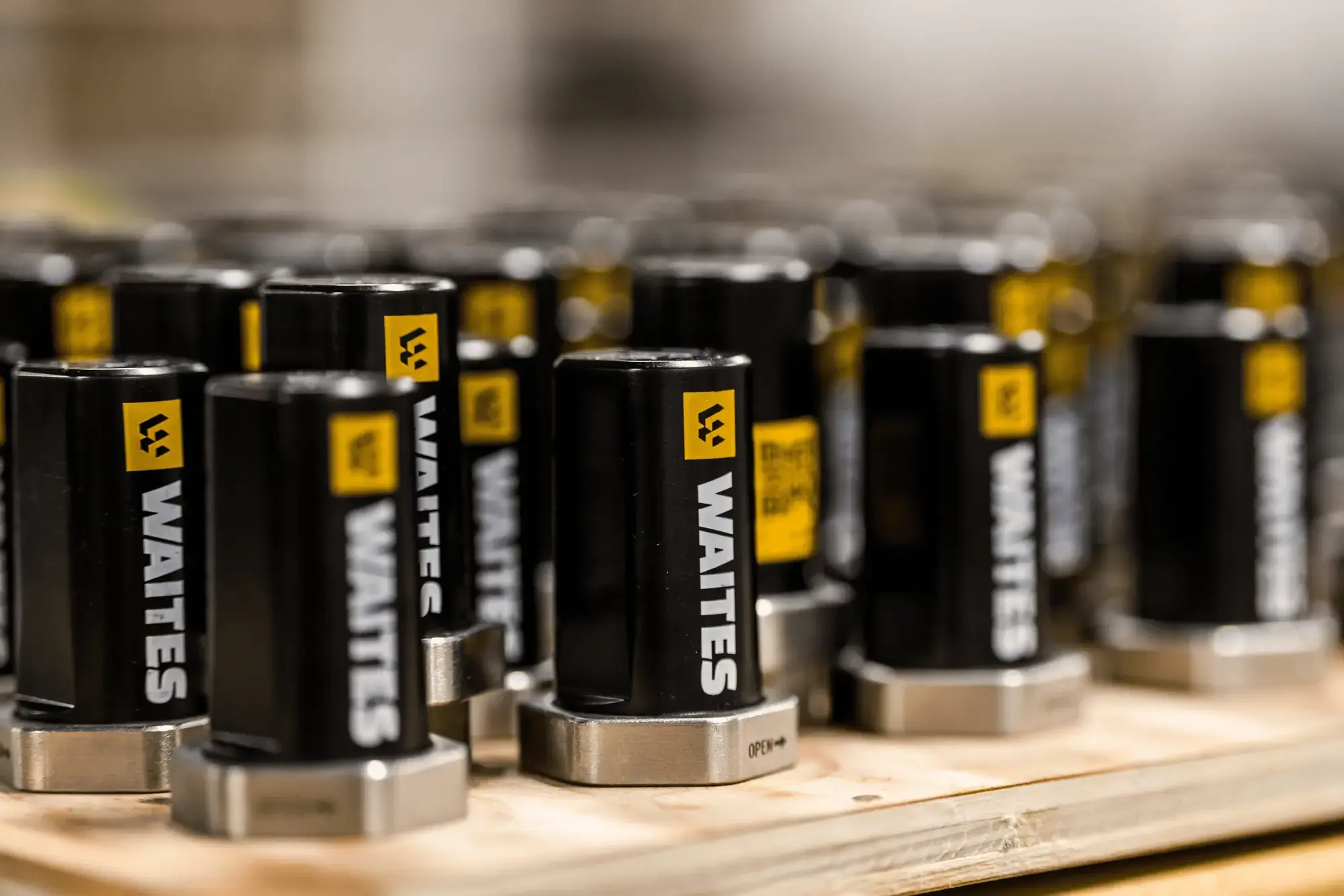
Waites sensors are designed for these conditions, not around them. Key performance characteristics for challenging environments:
- Frequency agility. Sensors dynamically select the cleanest available channel, reducing interference from VFDs, welding equipment, and adjacent wireless systems.
- Mesh-capable architecture. Sensors can relay signals through adjacent nodes rather than requiring direct line-of-sight to a gateway. This is particularly valuable in facilities with multiple machine halls or process areas.
- Robust enclosures rated for the real operating environment. IP69K and ATEX/IECEx certifications for hazardous area applications; extended temperature ranges for high-heat process environments.
- Configurable transmission intervals. High-frequency polling during known high-risk operating windows; reduced intervals during stable process conditions to preserve battery life and network bandwidth.
The data collected by Waites sensors feeds directly into structured analysis (vibration signatures, temperature trending, anomaly detection) that is reviewed by certified vibration analysts, not just flagged by an algorithm. The human expertise that interprets that data is not a limitation of the system. It’s the difference between a data stream and an actionable recommendation.
Decision Checklist: Wired or Wireless for Your Application?
Use this checklist to structure your decision before engaging vendors.
Installation factors
✅ Can cable runs be completed without a production shutdown?
✅ Is there existing conduit or cable tray capacity for new instrumentation runs?
✅ Are all target assets accessible to licensed electricians under normal operating conditions?
Equipment factors
✅ Do target assets have accessible, appropriate surfaces for external sensor mounting?
✅ Are data acquisition requirements above 10 kHz continuous (precision machining)?
✅ Is the RF environment assessed and understood for your facility layout?
Operational factors
✅ Can your team manage battery replacement or energy harvesting maintenance for wireless sensors?
✅ Is monitoring coverage likely to expand over time as the program matures?
✅ Is minimizing installation disruption to ongoing production a priority?
Scoring guide: If you answered NO to most installation questions and YES to most operational questions, wireless is almost certainly the right direction. If you have existing cable infrastructure in good condition and precision high-speed monitoring requirements, a hybrid approach may be warranted.
Detect Early, Act with Confidence
For aging industrial assets in manufacturing and heavy-process environments, the practical case for wireless condition monitoring is strong: lower installation cost, less production disruption, faster time to data, and an infrastructure that scales as your predictive maintenance program matures.
Wired systems remain appropriate in specific, narrow applications, primarily high-speed precision equipment or fully instrumented facilities where cable infrastructure already exists. For the broad majority of legacy retrofit scenarios, wired monitoring introduces more complexity than it resolves.
The more important question, after you've chosen the right delivery method, is what happens with the data you collect. Sensors don’t prevent failures. The analysis behind those sensors, specifically the reliability expertise that interprets it, is what separates a condition monitoring deployment from a predictive maintenance program that actually reduces unplanned downtime.
At Waites, we combine the best of both: sensors engineered for harsh environments and a human in the loop to verify your next steps to end downtime now.