How to Detect Gearbox Misalignment Before It Triggers a Shutdown
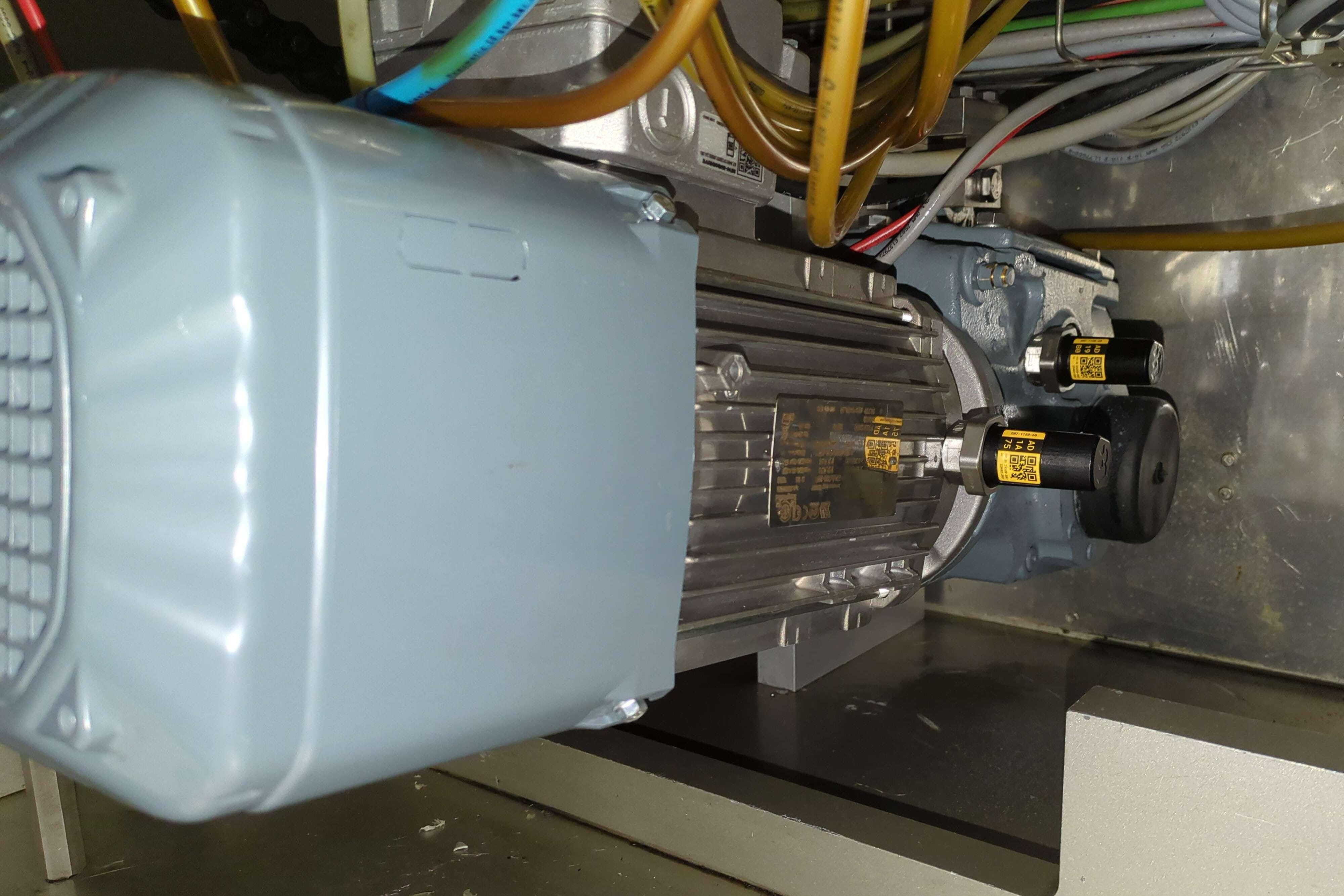
When a gearbox fails without warning, the costs add up fast through unplanned downtime, emergency repair crews, damaged downstream components, and missed production targets. Yet in most cases, the gearbox was signaling that something was wrong long before it stopped working. The problem is knowing how to listen and identify the issue at its source.
Gearbox misalignment is one of the most common and preventable root causes of industrial equipment failure. With the right monitoring strategy, and the right sensing technology, reliability teams can detect misalignment in its earliest stages, intervene before damage spreads, and avoid the shutdown entirely.
Let’s break down how misalignment develops, what your gearbox vibration analysis data is telling you, and how AI-powered condition monitoring and predictive maintenance can keep your operation running smoothly.
Why Gearbox Misalignment Leads to Equipment Failure
A properly aligned gearbox distributes mechanical forces evenly across its internal components, that is the gears, bearings, shafts, and seals, as they operate within designed tolerances. Misalignment disrupts that balance.
Gearbox case distortion can cause a deviation that, even a few thousandths of an inch between shaft centerlines, introduces uneven loading that the system is not engineered to absorb. This happens if the gearbox has a soft foot or if the frame that the gearbox is mounted to is twisted and/or distorted.
The consequences ripple through the entire drivetrain. Vibration and noise, typically a late-stage indication of gear misalignment, are often the most recognizable indicators of underlying mechanical stress. But by the time those symptoms are obvious to personnel on the floor, damage is already compounding:
🚨 Bearings issues typically cause gear misalignment problems.
🚨 Shafts flex under bending stress.
🚨 Gear teeth engage at angles that concentrate force on narrow contact bands rather than distributing it across the full tooth face.
Motor/gearbox input shaft misalignment and coupling issues are among the most common root causes behind this type of failure. Yet, they’re frequently overlooked during routine maintenance because the early indicators are subtle. As examples, a slight uptick in vibration amplitude, a minor shift in operating temperature, or a faint change in acoustics that gets written off as normal process variation.
Oil sampling and vibration analysis are recommended to detect and monitor early gear wear.
EXPERT ANALYSIS: “Something that can cause this uptick: normal operations over time. For example, the motor/gearbox is equipped with a grid or gear coupling that has had numerous across the line starts when the system is fully loaded. These little shock loads can shift the motor slightly over time until the vibration starts to indicate early signs of misalignment.”
Mark Kingkade
Reliability Solutions Architect and 30+ Year Vibration Analysis Expert
This is precisely where gearbox vibration analysis changes the game. Rather than waiting for symptoms to become unmistakable, vibration monitoring captures the mechanical signatures of developing misalignment and flags them before they escalate.
Waites analysts compare the vibration frequencies and amplitudes in the vertical, horizontal, and axial direction between the sensor on the motor and gearbox to verify whether there’s a misalignment issue versus an imbalance or a structural issue that can also produce high-running speed vibration.
Early Warning Signs Detected Through Gearbox Vibration Analysis
Gearbox vibration analysis works by continuously measuring the amplitude, frequency, and directional characteristics of vibration signals generated during operation. When misalignment is present, those signals deviate from established baselines in ways that are detectable, often weeks or months before a failure event.
Rising overall vibration levels are typically the first sign. As gears or bearings degrade, they introduce mechanical wear that manifests as unusual vibrations, cyclic wobble, or a sense that the gearbox is running “out of round.” Even small changes from baseline warrant a closer look.
Irregular frequency patterns are equally telling. A healthy gearbox produces predictable vibration signatures at known frequencies. Misalignment introduces sidebands and sub-harmonics that don’t belong, creating a frequency spectrum that experienced analysts and AI algorithms can flag as anomalous. Bearing frequencies should not be present unless there are defects or lubrication issues.
Heat and noise changes accompany mechanical stress. When the gearbox housing runs hotter than normal, or thermal hotspots develop near seals or bearings, internal friction or lubrication breakdown is likely at work. Similarly, when gear teeth begin to wear or mesh improperly, subtle grinding or scraping sounds often emerge, and typically become more pronounced under load or during speed transitions. Hearing this means a very late stage failure is happening. A gearbox with no load can have a noticeable rattle.
Small deviations in gear backlash, or the clearance between mating gear teeth, are another measurable indicator. Increasing backlash or lash variance signals deteriorating mesh alignment, which can progress to misalignment shock loads and eventually broken teeth.
EXPERT ANALYSIS: “These small changes in gear mesh frequencies can also help to identify early developing defects in slow speed bearings in larger gearboxes that may go unnoticed in their early stages.”
Mark Kingkade, Reliability Solutions Architect, Waites
The critical point here is that none of these signals appear suddenly. They trend. And trending data is predictive maintenance’s most powerful tool.
Understanding Gear Teeth Wear Patterns
The gear teeth themselves are a physical record of what’s been happening inside the gearbox. Wear patterns caused by misalignment are distinct from those caused by overloading or lubrication failure, and understanding the difference matters for both root cause analysis (RCA) and future prevention.
Pitting refers to small surface fatigue craters that form when contact stresses repeatedly exceed the material’s endurance limit. In a misaligned gearbox, pitting often appears on one side of the tooth or concentrated near one end, rather than distributed evenly across the contact zone. This uneven pattern is a direct fingerprint of off-axis loading.


Scuffing results from metal-to-metal contact when the lubricant film breaks down under concentrated stress. Misalignment accelerates scuffing because it forces gear teeth into contact geometries that squeeze lubricant out of the mesh zone. The result is a roughened, scored surface that increases friction, generates heat, and propagates damage rapidly.
Uneven contact patterns, sometimes visualized with marking compound during inspection, reveal where teeth are actually engaging versus where they should. A fully aligned gear set shows a uniform contact band centered on the tooth face. Misalignment shifts that band to one edge, dramatically reducing the effective load-bearing area.
These wear patterns correlate directly with what gearbox vibration analysis measures. Gear mesh frequency harmonics increase in amplitude as tooth surface integrity degrades. The rate of change in those harmonics, the trend slope, tells analysts how quickly damage is progressing and how much time remains before intervention becomes critical.
Using Predictive Monitoring to Prevent Gear Failure
Modern AI-powered condition monitoring systems contextualize anomalies within operational history, trend them against known failure signatures, and help reliability engineers make confident, data-driven decisions about when and how to act.
Predictive maintenance leverages data analytics, sensors, and machine learning to predict equipment failures before they occur, enabling timely interventions. For gearboxes specifically, that means correlating vibration data, temperature readings, oil analysis results, and operational load profiles into a coherent picture of asset health.
Consider this recommended scenario facilities could adopt as a better practice, provided they’ve done the foundational work. A gearbox on a conveyor drive train begins showing a 12% increase in gear mesh frequency amplitude over 6 weeks. Operating temperature at the output bearing climbs 4°C above its 90-day baseline. An AI-powered condition monitoring platform flags these trends together, cross-references them with known misalignment signatures, and generates an alert. A human in the loop, in our case a certified VCAT II or VCAT III vibration analyst, reviews this alert and creates an action item to prioritize scheduling an inspection within 14 days.
The maintenance team then pulls the gearbox during a planned weekend window. They find angular misalignment at the input coupling and early-stage pitting on the driven gear’s low-contact-side teeth. They correct alignment, replace the coupling insert, and return the unit to service. Total downtime: 11 hours, planned. Avoided outcome: catastrophic tooth fracture, potential shaft damage, and an estimated 72-hour unplanned outage.
By identifying developing issues early, teams can schedule maintenance during non-peak windows, minimize production interruptions, avoid costly emergency repairs, and extend gearbox service life.
The benefits add up over time. Maintenance planning becomes proactive, parts inventories are optimized around actual asset condition rather than calendar intervals, and AI systems grow more accurate as they learn asset-specific baselines with each monitored event.
Stop Waiting for the Warning Light
Gearbox misalignment doesn’t announce itself with a flashing alarm. It is detected in vibration signatures, wear patterns, temperature gradients, and frequency shifts that only become visible when there are eyes on the ground actively looking for them.
Waites specializes in the AI-powered condition monitoring solutions that make that visibility possible. Our 3-axis vibration monitoring technology captures the full mechanical signature of your rotating assets in near real time, feeding intelligent analytics that detect predictive gear failure signatures before they become operational crises.
If your team is still relying on calendar-based maintenance or waiting for a shutdown to tell you something went wrong, it’s time for a different approach.
Connect with our team of certified vibration analysts and reliability leaders to learn how Waites’ predictive monitoring system can protect your gearboxes and production schedule.
Frequently Asked Questions
What are early signs of gearbox failure?
The earliest signs show up in data before they’re perceptible to personnel on the floor. Rising overall vibration amplitude, shifts in gear mesh frequency harmonics, abnormal sidebands in the frequency spectrum, and gradual increases in operating temperature are the most reliable early indicators.
Oil analysis shows wear particles, water content, dirt ingestion, and additive breakdown. When these are present they jump start many of these issues.
Physical symptoms that follow include unusual grinding or clicking sounds, increased gear backlash, and oil contamination from metal particles shed by degrading gear teeth or bearings. Because these signs appear gradually, baseline data and trend analysis are essential for catching them before they escalate.
How does 3-axis sensing help detect gearbox problems?
A single-axis vibration sensor captures movement along one plane, typically radial to the shaft. But gearbox misalignment, bearing faults, and gear tooth defects generate forces in multiple directions simultaneously. 3-axis vibration monitoring measures movement in three orthogonal planes (radial, axial, and tangential) at once, giving analysts and AI systems a complete mechanical picture of what’s happening inside the gearbox. Helical and herringbone gear designs will show the gear condition the best when taken in the axial direction. By capturing all three axes simultaneously, 3-axis sensing detects fault types that single-axis systems routinely underreport, a comprehensive solution that enables more accurate diagnosis and earlier intervention.
Ready to move from reactive maintenance to true predictive intelligence?
References
- Mill Gears. Kusumgar, A. Predictive maintenance for industrial gearboxes. https://www.millgears.com/blog/predictive-maintenance-for-industrial-gearboxes
- Colorado Electric Motor Depot. 5 signs your industrial gearbox is about to fail — and what to do next. https://coloradoelectricmotors.com/blogs/gearbox-resources/5-signs-your-industrial-gearbox-is-about-to-fail
- CBM Connect. Tranter, J. Utilizing vibration analysis to detect gearbox faults. https://www.cbmconnect.com/utilizing-vibration-analysis-to-detect-gearbox-faults/