Wireless Condition Monitoring: No WiFi, No IT Headaches
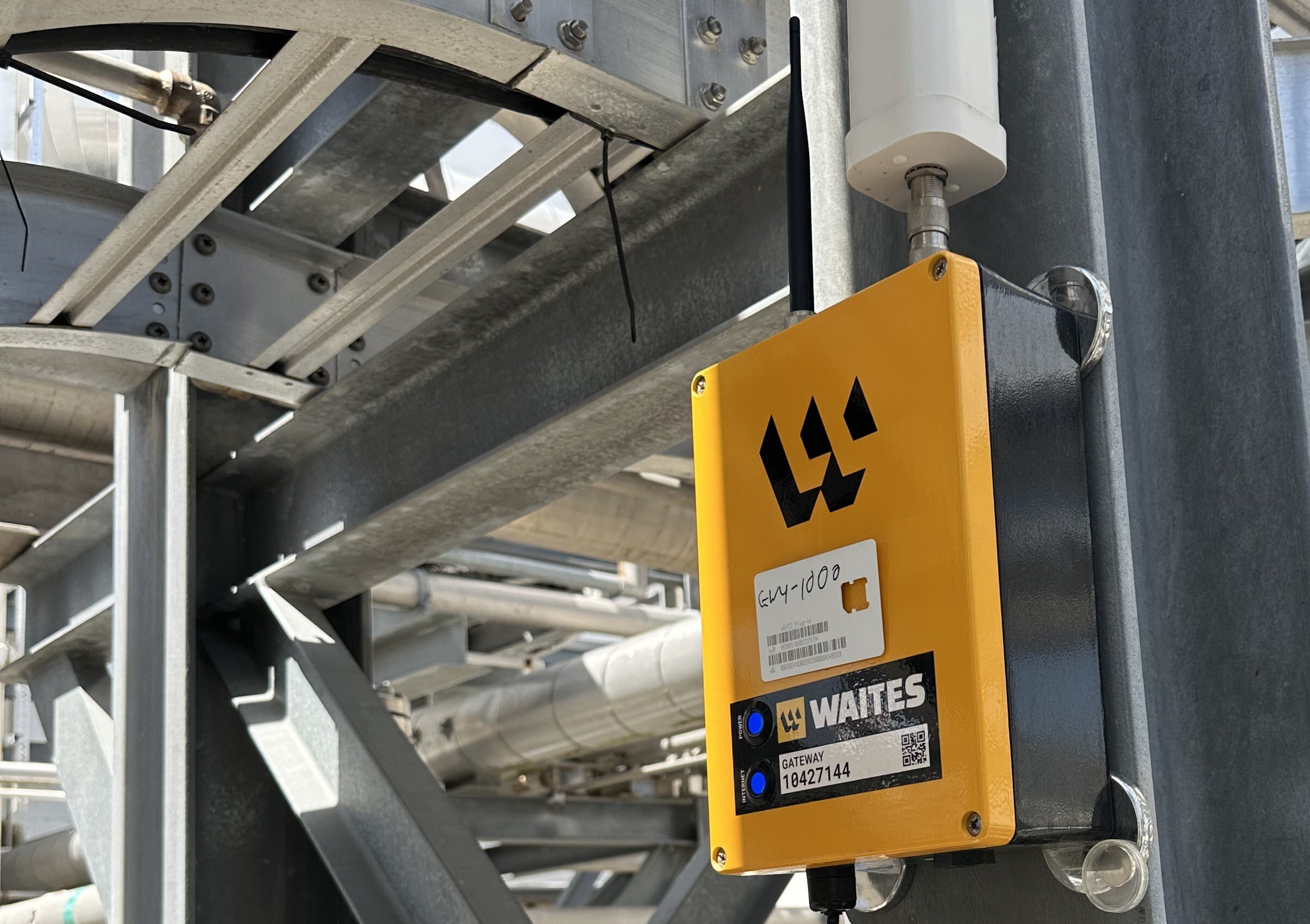
Wireless condition monitoring does not require access to your plant Wi-Fi, local Ethernet drops, or machine control networks. With Waites, sensors send data over a private, air-gapped mesh network to an outbound cellular gateway, so data typically starts streaming within hours of installation, with no IT tickets. For maintenance teams facing chronic staffing shortages and mounting preventative maintenance backlogs, this architecture delivers continuous vibration and temperature tracking without triggering an extended IT project.
Do condition monitoring sensors need to connect to plant Wi-Fi?
No, industrial wireless vibration and temperature sensors do not need to connect to plant Wi-Fi to deliver continuous condition monitoring. In fact, relying on facility Wi-Fi for machinery health data is usually the least reliable approach for an industrial plant.
Plant environments are tough on any wireless signal, and plant Wi-Fi isn’t built with machine monitoring in mind. Structural I-beams, heavy steel mezzanine grating, stainless steel enclosures, overhead crane runways, and thick concrete firewalls create severe signal attenuation, multipath interference, and localized dead spots. In a food and beverage packaging hall, washdown curtains and high-pressure steam drop Wi-Fi packets; in an automotive stamping or powertrain facility, high-frequency electromagnetic interference from robotic welding cells disrupts conventional wireless traffic. When an asset monitoring sensor loses its Wi-Fi connection, you lose trend lines, miss transient impact events, and risk unmonitored failures.
Instead of piggybacking on corporate access points, purpose-built systems use an industrial wireless mesh network. Sensors, nodes, and repeaters form a private mesh, and data hops device to device until it reaches a centralized gateway. Repeaters extend coverage around structural barriers and into remote areas. If an overhead crane moves or a temporary pallet rack blocks a direct pathway, the mesh dynamically reroutes data along an alternative line. The facility’s internal Wi-Fi network is never touched, never burdened with bandwidth, and never exposed to field-level device management.
Does predictive maintenance require PLC or OT network access?
Predictive maintenance systems do not require integration with your programmable logic controllers (PLCs), distributed control systems (DCS), or supervisory OT networks. Machinery health monitoring and automated process control serve two fundamentally different operational purposes and should remain strictly separated.
Your PLC network exists to execute deterministic, real-time machine logic: opening valves, indexing conveyors, sequencing robotic tooling, and enforcing emergency stop interlocks. Injecting high-frequency raw vibration waveforms and spectral data into an operational PLC or SCADA network introduces serious drawbacks:
- Control Loop Overhead: High-bandwidth vibration bursts can congest industrial fieldbus trunks (such as EtherNet/IP or PROFINET), risking communication timeouts on critical drive axes.
- Costly Integration Engineering: Interfacing with legacy PLCs requires custom ladder logic modifications, tag mapping, memory allocation checks, and costly PLC programmer contractor hours.
- Cybersecurity Exposure: Bridging secondary instrumentation directly into control layers expands the OT threat surface, requiring rigorous Purdue Model compliance audits and opening production lines to potential intrusion.
- Downtime Windows: Connecting to control cabinets typically demands scheduled production downtime to land I/O wires, install din-rail modules, and test communication loops.
Continuous condition monitoring operates completely out-of-band. Non-invasive sensors monitor physical bearing housing vibration and surface temperature externally. The data bypasses the machine’s control hardware entirely, eliminating production risks and leaving automation controls untouched.
Wi-Fi/OT monitoring vs. cellular mesh monitoring: A direct comparison
Deploying condition monitoring via existing plant IT/OT networks involves extensive coordination across multiple internal departments. Implementing a standalone cellular mesh system keeps the project entirely within the maintenance department’s control. The operational differences are outlined below:
| Operational Factor | Wi-Fi / OT Network Integration | Standalone Mesh + Cellular Gateway |
| Network Footprint | Requires connection to plant enterprise Wi-Fi or hardwired Ethernet drops at every machine center. | Self-contained industrial mesh; transmits to cloud entirely over an outbound cellular link. |
| IT/OT Engineering Scope | High. Involves static IP reservations, MAC address whitelisting, firewall pinholes, and PLC tag mapping. | Minimal. Zero local IP addresses, zero corporate network credentials, and no server infrastructure. |
| Cybersecurity Attack Surface | Connects edge devices directly to internal LAN/OT subnets, requiring Purdue Model security audits. | Completely air-gapped from internal networks; outbound-only encrypted cellular transmission. |
| Signal Resilience & Range | Prone to dropouts around structural steel, washdown partitions, and RF dead zones. | Self-healing mesh hops around obstacles; line-of-sight barriers bypassed automatically. |
| Time to First Asset Data | Often months of delay for IT security review, budgeting, and cabling before a pilot can even begin. | Typically within hours; sensors mount mechanically and data often goes live the same day. |
| Ongoing Management | Subject to corporate password rotations, certificate renewals, and IT network maintenance outages. | Managed autonomously by the reliability team without competing for internal IT tickets. |
The IT conversation: 5 questions to answer before you loop in IT
Your IT and OT engineering teams are responsible for protecting the plant against operational disruption, malware intrusions, and unmanaged network hardware. When maintenance proposes a new connected project, IT’s primary concern is preventing new cybersecurity risks or administrative burdens. Approaching IT with clear answers beforehand positions your team as a prepared partner.
Review this technical checklist before meeting with your IT manager:
- Where does asset data travel, and does it touch our local network?
Your Answer: “The system operates on an isolated private mesh network. Sensor data transfers exclusively to a cellular gateway and uploads directly to the cloud via commercial cellular carriers. It will not touch our corporate LAN, plant Wi-Fi, or switchgear.” - Does the cellular gateway require inbound listening ports through the plant firewall?
Your Answer: “No. The cellular gateway uses outbound-only transmission over cellular frequencies. It does not connect to the plant firewall, requires no inbound ports, and accepts no incoming connection requests from the public internet.” - Does this system expose proprietary production or recipe data?
Your Answer: “No. The sensors strictly capture physical mechanical telemetry: overall vibration velocity, high-frequency acceleration waveforms, and skin temperature from bearing housings. The system has zero connectivity to recipes, line speeds, production batch numbers, or PLC registers.” - Will maintenance need IT server space, virtual machines, or software maintenance?
Your Answer: “No. Data analysis and storage occur in a secure cloud environment accessed through an encrypted browser interface. There are no on-premise servers to patch, back up, or maintain.” - What physical infrastructure does maintenance need from IT?
Your Answer: “Zero network cabling or patch panels. The only requirement is standard 120V wall power for the gateway (or an optional solar/battery enclosure), which our plant maintenance electricians will install.”
Rolling this out across multiple sites? See How IT-Independent Wireless Sensors Scale Predictive Maintenance.
How long does it take to install wireless vibration sensors?
Deploying standalone wireless vibration sensors on plant machinery takes minutes per asset, allowing a full mechanical line to be instrumented in a single shift without shutting down production.
Because the hardware requires no conduit runs, communication wiring, or control cabinet tie-ins, mechanical installation follows a straightforward process:
- Position the Cellular Gateway: Mount the plug-and-play cellular gateway centrally within the facility where cellular reception is verified. Connect it to standard 120V convenience power.
- Mount the Sensors Mechanically: Mount sensors directly to bearing housings using solid-metal magnetic mounts, drill-and-tap studs, or industrial structural epoxy. Target rigid load zones on drive-end and non-drive-end bearings.
- Pair and Provision: Associate each sensor’s unique hardware ID with the machine asset name (e.g., “Boiler Feed Pump 2 Non-Drive End”) in the mobile interface.
- Establish Mesh Connection: The sensors automatically recognize neighboring nodes, join the private mesh, and begin transmitting baseline vibration and temperature data within minutes.
Rather than attempting to instrument every motor in the plant simultaneously, successful maintenance teams start with 15 to 30 critical assets—the chronic “bad actors” whose unplanned failure stops production. Instrumenting overhead exhaust blowers, boiler feed pumps, main case-packer drives, or cooling tower gearboxes provides immediate protection where an unexpected breakdown would be catastrophic.
Where Waites fits: Industrial mesh, cellular gateways, and zero data burden
Waites condition monitoring is engineered specifically to eliminate IT friction, survive punishing industrial operating conditions, and avoid adding analytical workloads to lean maintenance teams.
Which sensors hold up in washdown, high-heat, and steam-exposed areas?
Waites hardware is built from the plant floor up. High-precision wireless and tethered sensors are encased in IP66/IP68/IP69K-rated 316 stainless steel housings, engineered to withstand aggressive chemical washdowns in sanitary food packaging halls, high ambient heat around industrial kilns, and oil-saturated automotive machining centers.
The sensors communicate across a private industrial mesh built to coexist with Wi-Fi that routes data seamlessly to pre-configured outbound cellular gateways.
Crucially, Waites eliminates the greatest hidden failure point of predictive maintenance programs: alert fatigue and complex data handling. Maintenance teams do not have the bandwidth to interpret raw fast Fourier transform (FFT) spectra, velocity waterfalls, or time waveforms. Waites pairs advanced AI trained on 13+ trillion industrial sensor readings with continuous human expertise. Every actionable equipment warning is reviewed and verified by an ISO-certified CAT II–IV vibration analyst before reaching your team.
Instead of an unmanaged dashboard showing cryptic warnings, you receive clear, prescriptive guidance directly in your inbox or CMMS: which specific component is deteriorating (e.g., inner race bearing fault on motor drive-end), the root cause (severe lubrication degradation or angular misalignment), and the precise timeframe for scheduling the repair during normal planned downtime. Plant teams typically achieve full return on investment within 3 to 6 months by catching critical failures weeks before catastrophic seizure.
Frequently Asked Questions
What if our plant has weak cellular coverage inside steel-clad walls?
Waites cellular gateways utilize high-gain industrial antennas that can be extended outside metal structures or rooflines. Inside the plant, each Waites repeater extends the mesh about 1,000 meters (roughly 3,300 feet) line-of-sight, and up to three repeaters can be chained, so only the central gateway requires a cellular connection to transmit data to the cloud.
Who manages the cellular data plans and SIM cards?
Cellular data connectivity is completely turnkey and managed directly by Waites. The gateways arrive pre-configured with active industrial multi-carrier SIM cards. Your plant team never manages cellular carrier contracts, data limits, or SIM provisioning.
Will wireless mesh sensors interfere with existing plant radios or RFID?
No. Waites runs a low-power 2.4 GHz IEEE 802.15.4 mesh that is built to coexist with Wi-Fi and the other wireless systems in your plant. Because it is a separate network just for sensors, it never joins your plant Wi-Fi or touches IT-managed devices.
What ongoing support does our internal IT team have to provide?
None. Because the hardware does not reside on the corporate network, IT has no recurring passwords to rotate, no firmware patches to push, and no device certificates to manage. The maintenance department owns and operates the system autonomously.
Key Takeaways
- Zero Plant Network Burden: Modern wireless condition monitoring does not touch plant Wi-Fi, run through corporate firewalls, or interact with machine PLCs.
- Built for Harsh Realities: Standalone industrial mesh networks bypass heavy structural steel and RF dead zones that disrupt standard wireless signals.
- Rapid Non-Invasive Setup: Sensors mount externally to bearing housings in minutes without pulling communication conduit or scheduling machine downtime.
- Prescriptive Maintenance, Not Raw Data: Analyst-verified alerts deliver ready-to-execute work orders with specific fault diagnoses, eliminating dashboard fatigue for lean teams.
Ready to eliminate unplanned downtime without an IT headache?
Schedule a brief consultation with a Waites reliability specialist to discover which critical assets in your facility can be monitored in days—with zero plant Wi-Fi or PLC integration required.