CASE STUDY Slow-Speed Bearing Failure Detected Before Production Disruption
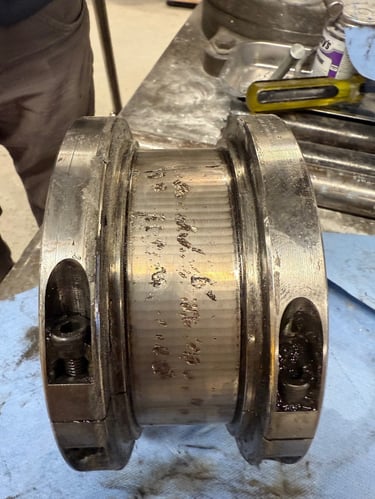
At a large North American flour milling facility, vibration acceleration on a slow-speed line shaft bearing began steadily increasing over time. While the asset continued operating normally and temperature readings remained relatively stable, vibration data revealed repetitive impact activity associated with developing bearing damage.
Because the bearing operated at low speed and remained properly lubricated, traditional temperature monitoring alone would not have provided sufficient warning of the defect progression.
Waites worked alongside the maintenance team to investigate the defect progression. The team evaluated lubrication conditions and monitored the asset through multiple operating cycles. Even after re-greasing, the vibration progression continued with no measurable improvement.
Using long-term vibration trends, TWF analysis, and analyst validation, Waites confirmed progressive rolling element bearing wear and recommended replacement of the split line shaft bearing before the condition escalated into failure.

Split bearing after replacement. Acceleration dropped significantly after repair, while temperature remained stable due to slow-speed operation and proper lubrication.
The maintenance team replaced the split line shaft bearing during a planned maintenance window, avoiding an unexpected production disruption and reducing the risk of secondary mechanical damage. Following startup, acceleration levels dropped significantly, validating both the diagnosis and corrective action.